The long view

130 years of being told what to eat

America has redrawn its official food advice roughly once a generation — chasing new science, new politics and new diseases of abundance. Each guide below is shown as it was structured, with the reason it eventually fell.

LAST REVIEWED · AUG 16 20268 GUIDES · 1894–2026

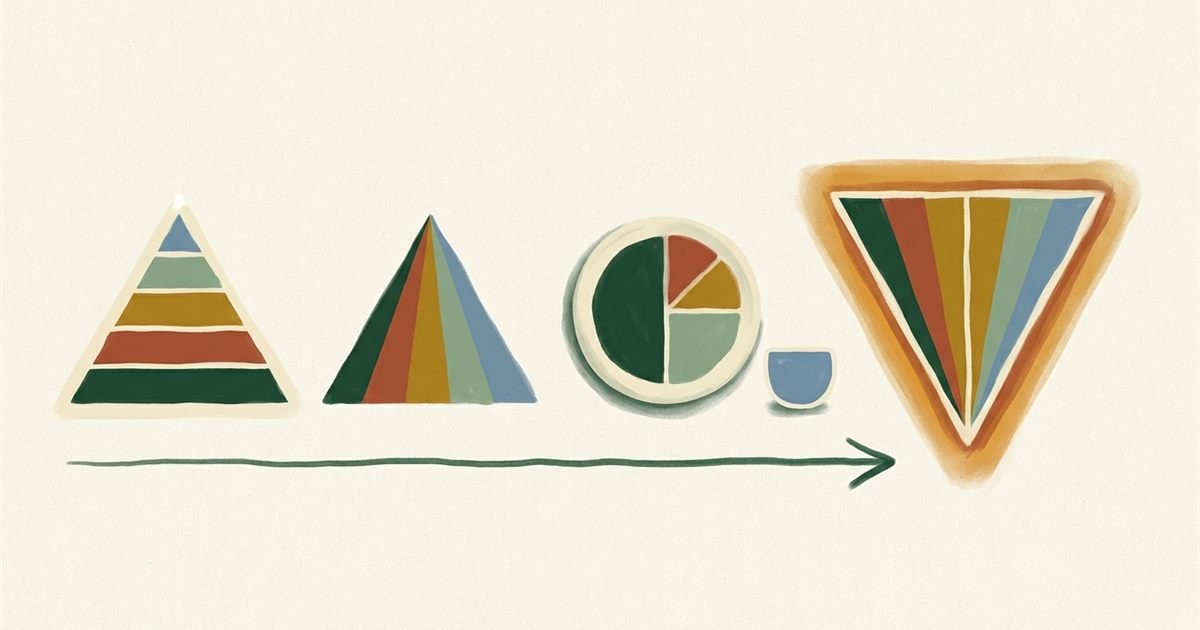
Illustrated evolution of American food guides: a banded pyramid, a striped pyramid, a divided plate, and finally the new inverted pyramid

1894 · The first tables Pre-vitamin era

Atwater’s food composition tables

Chemist W. O. Atwater published the USDA’s first dietary recommendations — tables of protein, fat, carbohydrate and “fuel value” for American foods, plus advice on eating in proportion to work. Remarkably, vitamins and minerals hadn’t been discovered yet.

Why it fellThe discovery of vitamins (“vitamines,” 1912) made nutrient tables alone look incomplete. Guidance shifted to food groups.
Nutrient tables, not pictures

1916 · The first food groups

“Food for Young Children” — five groups

Nutritionist Caroline Hunt wrote the USDA’s first true food guide, sorting foods into five groups: milk & meat; cereals; vegetables & fruits; fats & fatty foods; and sugars & sugary foods. The food-group idea has survived every redesign since.

Why it fellDepression economics and then wartime rationing demanded guides tuned to scarcity, not abundance.
Five groups, 1916

1943 · Wartime WWII

The Basic Seven

The National Wartime Nutrition Guide split food into seven groups — including a dedicated group for butter and fortified margarine — to help families stay nourished under rationing. It was patriotic, complicated, and famously hard to remember.

Why it fellSeven groups with no serving sizes proved too complex for everyday use. Post-war, it was simplified.
Seven groups on a wheel

1956 · Simplification

The Basic Four

“Food for Fitness” cut the seven groups to four — milk, meat, fruits & vegetables, and grains — with minimum servings for each. It anchored American nutrition education, school posters and cereal boxes for over two decades.

Why it fellIt said what to eat, but nothing about what to limit — just as heart disease and obesity research began pointing at fat, sugar and salt.
Milk · meat · produce · grains

1992 · The icon The famous one

The Food Guide Pyramid

The pyramid everyone remembers: a wide base of breads and grains (6–11 servings), vegetables (3–5) and fruits (2–4) above, dairy and meats (2–3 each) near the top, and fats, oils & sweets “used sparingly” at the tip. The pyramid shape itself was pioneered in Sweden in 1974 — see the world atlas.

Why it fellIts base didn’t distinguish whole grains from refined starches, and “low-fat” messaging aged badly as evidence on healthy fats matured. Critics also noted heavy food-industry lobbying over its proportions.
Grains 6–11 servings at the base

2005 · The abstract years

MyPyramid

The pyramid turned on its side into vertical rainbow stripes, with a figure climbing stairs to signal daily exercise — the first guide to build physical activity into the graphic. Personalized serving amounts lived on a website, not the poster.

Why it fellWithout labels, the stripes meant nothing at a glance. A guide that required a website to decode lasted only six years.
Stripes + stairs, 2005–2011

2011 · The plate

MyPlate

A four-section plate — half fruits and vegetables, plus grains and protein, with dairy alongside — designed to be understood in one glance at actual mealtime portions. It became the longest-serving U.S. guide since the Basic Four.

Why it fellThe 2025–2030 guidelines shifted federal messaging toward protein, full-fat dairy and “real food,” and a new administration wanted a new symbol. MyPlate was retired in January 2026.
Half the plate is produce

2026 · The flip Current

The inverted pyramid

Released January 7, 2026 with the 2025–2030 Dietary Guidelines: protein, dairy & healthy fats share the wide top with vegetables & fruits; whole grains sit at the tip; highly processed foods are named a public-health concern for the first time. The graphic itself carries no serving numbers, and grains at the tip is already its most debated feature.

What happens nextBy law the guidelines are reviewed every five years. The 2030 edition will decide whether the flip was a turning point or a footnote. Full breakdown here →
2026 — upside down

Sources & further reading

  1. USDA Center for Nutrition Policy & Promotion — A Brief History of USDA Food Guides. ACCESSED JUL 2026
  2. USDA National Agricultural Library — Historical Dietary Guidance collection (Atwater, Hunt, Basic Seven, Basic Four originals). ACCESSED JUL 2026
  3. USDA & HHS — Dietary Guidelines for Americans, 2025–2030. ACCESSED JUL 2026
  4. Harvard T.H. Chan School of Public Health — Assessment of the 2025–2030 guidelines. ACCESSED JUL 2026
  5. George Mason University — From plate to pyramid: understanding the new dietary guidelines. ACCESSED JUL 2026